How to Build a Personalized Nutrition Plan: Dr. Rosa Keller's Data-Driven Approach
How to Build Personalized Nutrition Plan
Most nutrition plans begin with a number: a calorie target, a protein goal, a list of foods to eat or avoid. Numbers can be useful. But a number without context is just a number.
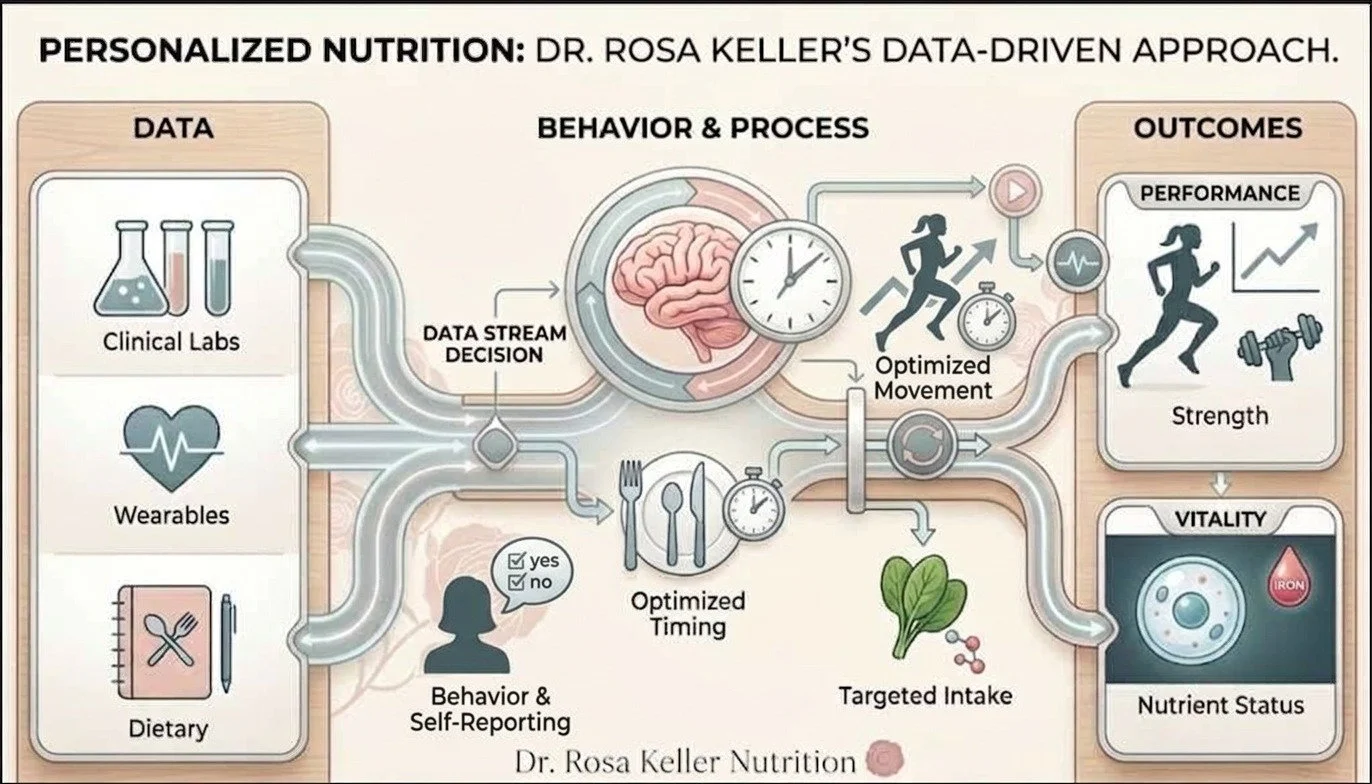
When I work with performance clients, I start by asking what's actually driving the outcome we're trying to change such as training load, recovery, sleep, hormones, gut function, or something behavioral entirely, then I go find the data that can answer that question. Not the other way around.
A Composite Example
A client comes in fatigued, plateaued in strength gains, with poor sleep scores on her wearable. The generic answer is "eat more protein and sleep more." Here's what the data actually showed:
HbA1c: [5.4]% — in range, ruled out a glucose-regulation issue as the driver
DEXA: lean mass stable, but body fat trending up over 3 months despite unchanged training volume
Clinical labs: low iron status
HRV (wearable) + sleep score: HRV trending down, sleep efficiency dropping; but only on weeknights, not weekends
Cronometer log: caloric intake looked "adequate" on paper, but carbohydrate timing was backloaded to dinner, with almost nothing before or during training. Little to no breakfast or nutrition during the day and a lot of evening snacking.
The plan wasn't "eat more." It was shifting carbohydrate timing earlier in the day around training, and treating the weeknight-only HRV drop as a signal to look at her evening routine rather than her diet. [Outcome after 6 weeks: e.g., HRV normalized, strength gains resumed, sleep score improved, iron status improved with increase iron rich foods
None of those five data points would have told the full story alone. The HbA1c ruled things out. The DEXA showed a trend a scale wouldn't. Nutrient intake was improved and overall energy as well related to protein and iron. The wearable data pointed to a pattern, not just a number. That's the actual value of combining data streams. It’s not that more data is better, but that each stream rules something in or out.
Data Is a Tool, Not the Answer
More data does not automatically mean better nutrition. The goal is to find the smallest set of information that actually changes a decision. For one client that might be a hormone panel and a food log. For another it might be training data and sleep alone. I don't run every test on every client. I run the tests that can move the plan.
Gut Microbiome: A Piece, Not a Prescription
Gut microbiome testing can offer real information about microbial diversity and the organisms present. Current evidence supports it as useful for identifying patterns tied to specific GI symptoms; it does not yet support using a microbiome report to write an entire diet from scratch. The research connecting specific microbial profiles to prescriptive food lists is still early.
So the report is one input I weigh against symptoms, existing dietary pattern, and training demands. The question I'm answering isn't "what does the test show" — it's "does this specific finding change what I'd otherwise recommend." Most of the time, for most markers, the honest answer is no. One benefit of the test is that we can be more strategic when choosing supplementation and certain foods aimed to improve gut microbiome composition and digestion.
Genetics: Only When the Evidence Holds Up
Genetic testing can add context on how someone may respond to certain nutrition variables, but the evidence quality varies enormously by gene. Some variants (for example, those affecting caffeine metabolism or lactose tolerance) have reasonably strong, replicated evidence behind them. Many others marketed in consumer nutrigenomic panels have thin or single-study support. I use genetic results selectively, weighted by how much evidence actually backs a given variant.
Clinical Labs and Body Composition
Bloodwork and DEXA scans are useful for a different reason than most people assume: not to chase an "optimal" number, but to catch a trend before it becomes a problem, or to rule a variable out entirely. A single HbA1c in range doesn't tell you much on its own. An HbA1c in range combined with a nutrient intake, energy levels and a hormone panel starts to narrow down what's actually happening.
Turning Data Into a Plan
Once I have the relevant pieces, the work is interpretation: identifying which one or two things are actually limiting progress, and building the plan around those including protein targets, carbohydrate timing, training-day fueling, and meal timing rather than trying to optimize everything at once. The plan has to fit an actual training schedule and an actual life, and it has to change as new data comes in.
The Goal Is Better Decisions
Personalized nutrition isn't about collecting every possible test. It's about using the smallest set of the right information to make a specific decision you couldn't have made with guesswork alone.
Ready to Take a More Data-Driven Approach?
If you're training toward a specific performance goal, the Precision Performance Program pairs targeted testing with personalized nutrition, wearable tracking, and one-on-one coaching — built around the data that actually moves your plan, not a standard panel run on everyone.